
Of all genres, horror is the one where most readers seem to have several reservations. They won’t read horror that includes harm towards or death to animals, or any horror novel that includes harm to children. However, many horror novels have included children that have either witnessed or experienced horror, and there is even a subgenre of children’s horror.
But the question remains: Should children be included in a horror story? Some parents have mixed feelings about this. 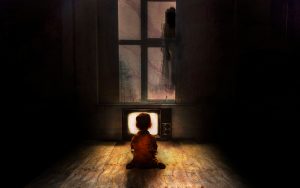
“Paternal instinct is one of our greatest evolutionary instincts, just as, if not more so, powerful as the fear of the dark or the fear of heights,” William Becker, an author and father of a four-year-old daughter, said. “To protect your children or just children in general is an urge that is inherently part of the human experience. That’s why the issue of featuring children in horror is complex and entirely depends on intent. When done correctly, it can speak to the most primal anxiety possible. Children represent the most innocent and vulnerable members of society. A great example of this, while not horror, is that when trying to truly portray Anakin Skywalker as a monster in Star Wars, George Lucas has his character slaughter children. That’s when he loses the sympathy of the audience. By contrast, it also is an easy low blow. An emotional gut punch. The equivalent of Old Yeller dying at the end of the movie. It’s the easiest way to get an emotional reaction from the audience. It can be cheap if not earned, including children. They can also represent a unique and youthful perspective, as is the case of a story like IT by Stephen King (barring the child orgy).”
With movies, we seem to see a lot of them. Films such as Poltergeist, Children of the Damned, The Omen and Pet Sematary have depicted children either in the throes of horror or being a little horrific themselves. Such movies seem to have escaped the criticism of those who draw the line of children being in horror stories, but horror books continue to draw judgment if they include children.
“Children are a pivotal part of storytelling because they feel things more simply and directly than adults do, and don’t always react how we think they should,” noted Desiree Horton, author of the horror short story collection Tell Me How It Ends. “Those situations are great for showing us truths about ourselves we may not normally see.”
For the most part, adult writers of today were once young readers of the spooky Goosebumps series, so we understand that being exposed to horror stories at a young age is not as traumatizing as many adults of today would believe. However, most children’s horror books, as well as horror books that include children, often portray horror stories that are a little more intense than the Goosebumps books.
Take, for example, Stephen King’s novel. ‘Salem’s Lot, in which a young boy named Danny is turned into a vampire. This young vampire goes on to torment his friend, Mark, trying to turn him into a vampire. Mark is too smart for Danny, however, realizing that there is something very wrong with seeing his dead friend floating at his bedroom window. Likewise, in King’s other novel The Shining, young Danny Torrance not only witnesses horrific scenes of murder, even though these images flash into his mind, but he also has to face the reality that his father is trying to kill him. These examples show that children often respond to horrific situations much more differently than how adults would, and sometimes the actions they take tend to be the better choices.
“I think children have a place in horror fiction,” Jerry Blaze, author of the award-winning children’s horror book, Nightfall at Kirby Manor, said. “Children are the most innocent incarnations of humanity, and when they are in danger, it adds a whole new layer of tension to the story. And it really sets a lot of stories apart.”
While horror novels and story collections that are a little too intense for children that do include children may reflect how resilient children can be in facing and overcoming traumatic experiences, this message is lost to readers decrying the inclusion of children in such horrific tales to start with.
For this reason, many authors of children’s horror books have made an effort to water down their stories to make them more kid-friendly. While such books may not be very scary to most readers, they have the “just right” level of scares that make the stories safe for young readers.
Authors Banunu and Yennie Fer achieved this goal with their children’s horror novel Don’t Call Them Cute. At the same time, however, they acknowledge that while kids can be exposed to horror through books, video games, and movies, they may also experience it in real life. “Perhaps, especially in this day and age, with technology and schools, there are no ways to fully protect kids from horror,” Yennie Fer explained. “People go out shopping, and there could be Halloween props. It’s good to educate kids on what’s real and what’s not. It’s better to be enlightened instead of being in the dark.”
For children, horror remains a genre and movie category that stays “off limits” until parents or guardians have had a chance to review them first. And while most books that fall under “children’s horror” meet the watered-down guidelines to make the book safe for young readers, most horror novels and story collections are written for readers old enough to tolerate that degree of horror. Authors of such books should be allowed to include children in their stories if the stories call for such inclusion, and they shouldn’t be judged or ostracized for how they include them. It’s horror, after all, and in horror, hardly anybody manages to get out of it alive.
- About the Author
- All Posts by This Author
