
Submitted for your approval, an angelic being of such beauty the only name fitting for them is Lucifer or “Morning Star”. This angel begins to assume they deserved a higher status; this entitlement inspires Lucifer to aim for the top. Instead of the top, this Morning Star falls to the bottom to a place we call…the Twilight Zone….er, Hell. In the Judeo-Christian belief system, this is the origin story of their adversarial figure, the Devil. For a multitude of faiths and cultures this entity, or an adjacent creature, is seen to be nothing less than the personification of evil. Beyond the realm of the religious, the deeds and legends of Old Scratch have fueled the imagination of countless storytellers for millennia. Even one of the greatest storytellers of the twentieth century, Rod Serling, was more than willing to incorporate the Devil into his heralded magnum opus, The Twilight Zone. 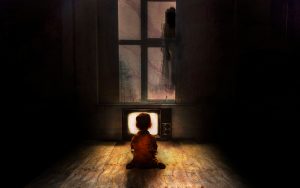
During the earliest years of television becoming mainstream, Serling established himself as one of the brightest talents of this new medium. In 1959, the Binghampton, New York native achieved pop culture immortality thanks to his strange, terrifying, and thought-provoking creation, The Twilight Zone. Premiering on CBS, this anthology series would lay the foundation that all scary and cerebral genre television would be built upon, and Serling himself served as host in a dimension of both shadow and substance. Through five seasons, this series gave audiences a terrifying menagerie of now iconic monsters and otherworldly creatures; from the gremlin tormenting William Shatner’s flight in “Nightmare at 20,000 Feet” (season 5 episode 3) to the “miniature” otherworldly attackers Agnes Moorehead faced in “The Invaders” (season 2 episode 15). On a surface level, they fueled countless nightmares for those who tuned in, but more importantly these creatures were the vessels for Serling and his writers to explore deeper issues concerning society and the human condition. After all, as the intro informed audiences they were entering a “dimension not only of sight and sound, but of mind” with thought-provoking concepts that were not always comfortable.
In his piece “Televising the American Nightmare: The Twilight Zone and Postwar Social Criticism”, Louisiana State University history professor, Dr. David Brokaw observed how Rod Serling appraised the priorities of Post-World War II white mainstream America/ Serling’s critical eye examined both rampant consumerism and a willingness to overlook societal injustices. As a passionate crusader for peace, equality, and social justice, Serling’s largest viewing audience were the exact people he was targeting with his criticisms and commentary. The Emmy-winner guided viewers past a door that is unlocked with the key of imagination to explore the darker truths beneath the veneer of the country’s post war prosperity. Considering this, it makes sense that the Prince of Darkness was a frequent presence in the series, but not in the way many may have expected. Serling was less interested in the traditional beast with red skin and horns or a figure of religious symbology. Instead, The Twilight Zone took Satan back to the source material, so to speak: a conniving deceiver exploiting the vulnerabilities inherent in humanity.
From the debut season, the Serling-penned episode “Escape Clause” (season 1 episode 6) told audiences to forget about the pitchfork-wielding scoundrel they were perhaps expecting. Instead, the Devil took on the appearance of an ordinary middle-aged man in a suit, calling himself Cadwallader. He was on hand to make an offer to one Walter Bedecker, a character Serling introduced as someone who feared “death, disease, other people, germs, draft and everything else”. This made him the ideal candidate for Cadwallader’s proposal: eternal life in exchange for a soul. Immediately Bedecker’s lifestyle transformed from drowning in exaggerated or nonexistent maladies to partaking in normally fatal activities-both for fun and for the frequent insurance payouts that followed. The episode culminates with the hypochondriac murdering his own wife in the hopes of catching a jolt from the electric chair as the ultimate use of his supernatural invulnerability.
Of course, this wouldn’t be an episode of the Zone without a wicked twist, as Bedecker’s planned trip to death row instead took a detour to a life sentence. Bedecker’s lifelong hypochondria led to a fixation on death and dying. When granted the gift of immortality his worldview didn’t permit him to partake in anything enriching like traveling the world or spending time with loved ones. Instead, he squandered this gift jumping from tall buildings and walking into traffic. Perhaps Aristotle put it best: he was “preoccupied with living, not with living well”. A s soon as Bedecker shook hands with the Devil it was only a matter of time before he called in the “escape clause” to surrender his Satanically-gifted invincibility finally give up his damned soul.
While trading in human souls is the typical MO of Satan, in the episode “Of Late I Think of Cliffordville” (season 4 episode 14) the greedy soul of William J. Feathersmith had already been condemned to an eternity of fire and brimstone by the time he met the Devil. Instead, the Prince of Darkness, or Princess of Darkness in this case, takes something he actually values: money. Showcasing his own feelings on corporate greed, Rod Serling’s intro didn’t hesitate in equating Feathersmith’s business practices to murder. Using underhanded means to buy out a former employer Feathersmith becomes a self-proclaimed Alexander the Great of industry with no more worlds to conquer. But a supernatural travel agent named Miss Devlin, portrayed by Julie Newmar of Batman fame, presented him with a tempting offer to travel back to his younger years, armed with his contemporary knowledge, and build his empire once again, only this time as a purely sporting endeavor by getting in on the ground floor of coming innovations.
However, Feathersmith doesn’t know how to build or create the instruments that shape society, only how to throw money around until hitting on luck. Pitches to an engineer for electric motors and airplanes are met with mockery as, without the required know-how, they are mere objects of fantasy. He dropped a fortune on a plot of land with vast oil reserves only to find that the drill needed to get to it is still years from being invented. In his essay “Social Justice from The Twilight Zone” science fiction writer and scholar Hugh AD Spencer wrote that Rod Serling “gave voice to the people in the margins and questioned the rules for holding power” and there is no doubt that Feathersmith is part of that “power” class. He bullies and demeans those he thinks of as lesser while still relying on them in various capacities to build his empire and when he can no longer do this, he has nothing. In the culmination of the episode Miss Devlin ensured he knew this as she gloats that he is nothing more than “a taker instead of a builder, a conniver instead of a designer”.
Punishing the wicked is but one of Satan’s duties; the former angel is also tasked with instrumenting the downfall upon the just. In one of his many trips into the fifth dimension, Burgess Meredith portrayed an incarnation of the Devil that proved even decent people were susceptible to the right temptation. In “Printer’s Devil” (season 4 episode 4) the dangerously charismatic “Mr. Smith” makes a deal with Douglas Winter, editor of a struggling newspaper. Initially, he takes on the now antiquated position of linotype operator, but it becomes quickly apparent that he has a supernatural ability to predict the horrendous news that is printed. In the 1960’s just as today, “if it bleeds it leads” is the guiding philosophy of media meaning Winter’s newspaper finds success in its tragic headlines. We as an audience know that he has made a deal with the Devil, but ever the journalist, Douglas Winter, maintains his skepticism for as long as possible. Luckily, he has the moral scruples lacked by the likes of Walter Bedecker and overcomes the temptation of Satan. But being a decent person is no indicator of success against the Prince of Darkness in the dimension of sight, sound, and mind.
In “The Howling Man” (season 2, episode 5) the good intention of a weary traveler is ironically what makes him the perfect prey for the schemes of the Devil. In an isolated monastery Brother Jerome claims to have imprisoned the Devil himself. But who the Holy Man calls the Father of All Evil, David Ellington regards as a suffering prisoner howling in despair. As any of us in his position would likely do, Ellington releases the poor man only to learn the horrifying truth. “The Howling Man” is a standout in that it is the sole indulgence of giving viewers a traditional Devil figure in The Twilight Zone. Episode writer Charles Beaumont opposed this as he penned a more subtle revelation contained merely to a shot of cloven hooves. However, at the end of the day television is a visual medium that sometimes demands spectacle. The essay “The Twilight Zone: The Evil Men Do” defends this change believing it only enhances the moral of the story that people tend not to recognize evil right in front of them until the consequences make the truth inescapably clear.
It is reasonable to believe that once the Grim Reaper comes calling, any dealings with the Devil should come to an end. But that is not the case in the realm between the pits of man’s fear and the summit of his knowledge. Many citizens of the Zone found themselves in the Hereafter region that lies in the fifth dimension. For instance, the character of Rocky who was shuffled off this mortal coil as a result of this life of crime in the episode “A Nice Place to Visit” (season 1 episode 28), undoubtedly expecting an afterlife with no shortage of fire and eternal torment. Rocky is somewhat surprised to meet his “guide” Mr. Pip who is on hand to ensure his utmost comfort. Played by Sebastian Cabot, an actor famed for wholesome fare like Family Affair and multiple Winnie the Pooh specials, there is little reason to believe Pip is anything more than the genial old man cheerfully delivering on Rocky’s every desire. A nonstop supply of women, money, and booze leave the formerly-living crook feeling heavenly so to speak despite the nagging certainty that he doesn’t deserve this. Over time, we see the joy he once received from these vices devolves to boredom and eventually stifling mental anguish. The episode culminates with Rocky questioning Pip as to how Heaven could be devoid of any joy or fun to which Pip reveals he is not in Heaven…and what could have possibly led him he was? Perhaps if Rocky had been able to look past his own selfishness in life he could have made a four-legged friend as Hyder Simpson had in Rip in the episode “The Hunt” (season 3 episode 19). After all this canine allowed him to recognize the Devil’s trickery during their shared journey to the afterlife.
When it comes to how the Prince of Darkness is portrayed in The Twilight Zone, the piece “The Devil is in the Details: Twilight Zone’s Demonology of Capital” put it best: he is “more bureaucratic than theocratic”. There are no pitchforks or brimstone with this version of the Devil, instead his tools of trades are contracts and promises for desperate people. Rarely does Satan attempt to disguise the truth; early on in “Of Late I Think of Clifforville” Devlin doesn’t hesitate to remove her hat to reveal protruding horns. From the moment of introduction in “Escape Clause” Walter Bedecker recognizes the true identity of Cadwallader. There is a certain irony to the fact that these characters instantly recognize the presence of Satan but not the threat posed by the deal he is offering. The enormity of their greed clouds their judgment of the obvious. Despite being the personification of evil, Satan never once forces Bedecker or Feathersmith or any of the others in these episodes into anything against their will.
A monster reeking of sulfur and brimstone engulfed in flames would not be out of place in a series famed for pushing the boundaries of what could be done in genre television, but it would be ill-fitting to Serling’s vision. Let us not forget, for all the ghoulish creatures and aliens The Twilight Zone unleashed on TV screens, many of the show’s most horrific monsters are disturbingly human. Few viewers will ever forget Anthony, a spoiled sociopathic child gifted with omnipotence in “It’s a Good Life” (season 3 episode 8), or the self-absorbed Harper family in “The Masks” (season 5 episode 26). Typically, when Satan enters the Fifth Dimension, it is either with the affable charm of a Burgess Meredith or Sebastian Cabot or with the sex appeal of Julie Newmar. In the fan-favorite episode “Nick of Time” (season 2 episode 7) the image of the Devil is nothing more than a piece of silly décor on a novelty fortune-teller taunting an increasingly desperate couple. This likely stems from the fact that Serling’s creation came from a desire to reflect society with a mirror made of genre fiction. As such, it was perhaps fitting to give viewers a version of evil that is relatable where humanity doesn’t understand the consequences until it is too late. Look no further than the conclusion of “The Howling Man” where an aged David has finally recaptured Satan and we see him off to make arrangements to return him to Brother Jerome’s prison. This leaves his well-meaning housekeeper alone with a man howling begging to be released which would unleash Satan to once again torment those who reside in…the Twilight Zone.
- About the Author
- All Posts by This Author

Josh Plock has written about some of the most iconic figures in popular culture with contributions to the acclaimed books: The American Superhero, The American Villain, and Robots in Popular Culture published by Bloomsbury. In 2022 he was the co-author of the book We Are Gotham exploring the dark corners of the most iconic city in fiction. Beyond the bookshelf his work has been featured on popular blogs like the House of Geekery and Horror Bound as well as printed in the pages of Ghostwatch Paranormal Zine. Josh is proud to call the city of Memphis his home where he and his wife reside. You can follow him on Instagram at @joshthemonster86.